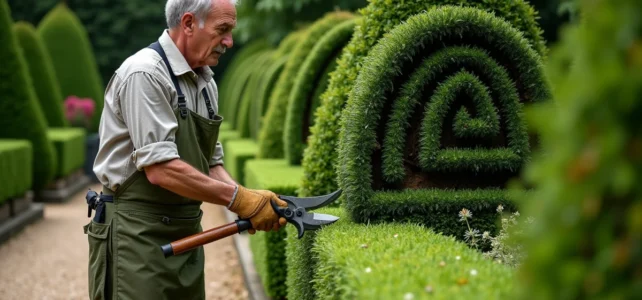
A shrub trimmed into a ball at the end of a path changes the perception of the entire space around it. The sculpture of hedges and topiary art is based on this principle: giving a precise shape to a plant to structure the garden. This know-how, practiced since Roman antiquity, is making a comeback in private gardens with approaches that are more free and accessible than one might imagine.
Frequency of trimming and maintenance: what keeps topiary lasting over time
You may have noticed that a boxwood trimmed into a sphere loses its shape in just a few weeks without maintenance? Topiary is not a one-time action. It is a commitment to regularity.
The main difficulty is not creating the initial shape. It is maintaining it season after season. Keeping beautiful topiary shapes is primarily a matter of regularity, controlling regrowth, and precision of the eye. A cone of boxwood or a spiral of yew requires several trimming sessions per year, concentrated between spring and the end of summer.
Every uncontrolled regrowth distorts the silhouette. On a simple geometric shape (ball, cube), a delay of a few weeks can be corrected. On a complex shape (animal, twist), the slightest imbalance is immediately noticeable. Professionals specializing in architectural trimming emphasize the use of appropriate tools: hand shears for precision, lightweight hedge trimmers for flat surfaces, and metal templates for demanding shapes.
Resources like sculpte-haie.com help to better understand the techniques and materials associated with this practice.
Shrubs suitable for hedge sculpture: boxwood, yew, and alternatives
Not all plants are suitable for topiary trimming. The choice of plant determines the finesse of the result and the frequency of maintenance.
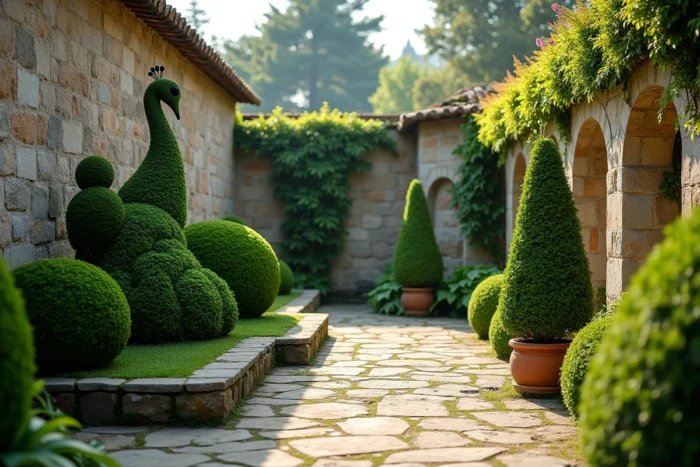
Plants with evergreen foliage and slow growth are the most suitable. Boxwood remains the historical reference: dense foliage, small leaves, good tolerance to repeated trimming. Yew (Taxus baccata) offers a more disease-resistant alternative, with dark foliage that creates sharp contours.
Why these species and not others? Because evergreen foliage guarantees a visual effect all year round. And slow growth limits the number of trims needed to maintain the shape.
- Common boxwood (Buxus sempervirens) accepts very detailed shapes but is sensitive to the box tree moth, a pest that can devastate a plant in just a few weeks.
- Yew tolerates severe trimming and even regrows on old wood, making it more forgiving of cutting mistakes.
- Cherry laurel (Prunus laurocerasus) is suitable for broad shapes and sculpted hedges in volume, but its large leaves limit the finesse of detail.
- Privet (Ligustrum) grows faster and thus requires more frequent maintenance, suitable for simple shapes like cubes or battlements.
For a first attempt, starting with a yew or a boxwood already shaped in a nursery makes it easier to get started. Shaping a shrub from scratch requires several years of patience.
Topiary shapes for modern gardens: beyond the ball and cone
Competitors often talk about classic geometric shapes. These are the most accessible, but contemporary topiary goes further.
The gardens of La Ballue, in Ille-et-Vilaine, offer group visits focused on the staging of sculpted hedges. This site illustrates a trend: topiary is becoming a motif for visits in its own right, not just a simple backdrop. The displayed shapes blend strict geometry with organic volumes, far from just the classical repertoire.
In a private garden, this approach translates into less expected shape choices. A hedge trimmed into continuous waves creates a sense of movement. A group of three shrubs trimmed to different heights produces a visual rhythm without resorting to complex figurative shapes.
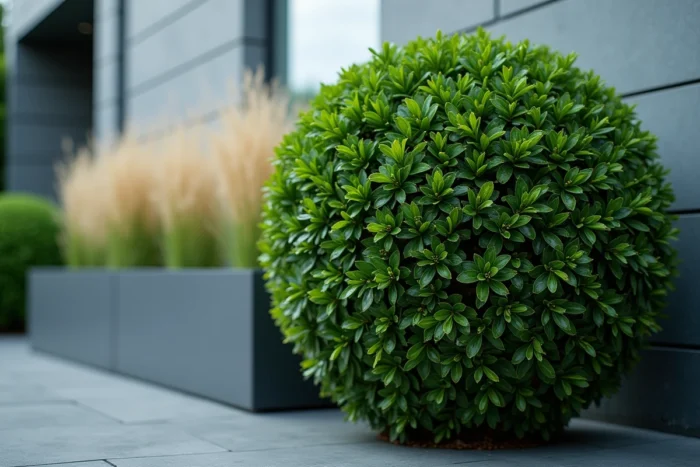
The template remains a valuable tool for elaborate shapes. It is a metal framework placed around the plant, serving as a cutting guide. The template does not replace know-how, but it secures the action and allows for achieving a symmetry that is difficult to maintain with the naked eye.
Common mistakes in topiary trimming and how to avoid them
The first common mistake is trimming too late in the season. A cut in autumn stimulates tender regrowth that does not withstand frost. The last trim of the year should allow the plant time to heal before the first cold weather.
Another trap: trimming in humid weather. Cutting wounds on wet foliage promote fungal infections. Always trim in dry weather, preferably overcast, to also avoid sunburn on fresh cuts.
Choosing a poorly sharpened tool causes underestimated damage. A shear that crushes instead of cutting leaves irregular edges, browns the foliage, and slows healing. Proper sharpening before each trimming session protects the plant as much as the aesthetic result.
- Do not cut more than one-third of the volume at once, or you risk stressing the shrub to the point of blocking its regrowth.
- Check the shape by stepping back several meters regularly, as symmetry defects are not visible up close.
- Feed the soil at the base of the topiary after each trim (compost, mulch) to compensate for the regeneration effort required by the plant.
The sculpture of hedges and the creation of artistic topiaries transform a garden provided one accepts regular work. The result does not depend on a single spectacular gesture, but on an accumulation of precise trims, spaced a few weeks apart, on shrubs chosen for their ability to endure this discipline. A topiary garden is built over several years, and it is precisely this slowness that gives it its value.