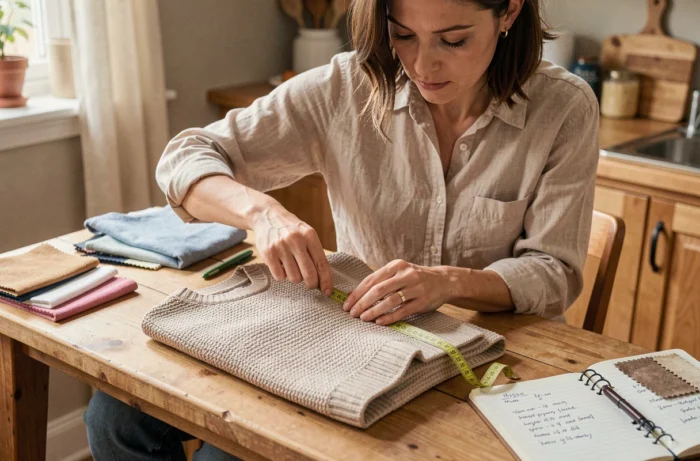
Estimating the size of a children’s garment when the label is missing relies on concrete measurements, not on a visual guess. Sizing systems vary by brand and country, making age-to-size matching unreliable once the label reference is lost. This article details the measurements to take on the garment itself, the discrepancies between brands, and a safety point often overlooked.
Flat measurement of a children’s garment: the method that replaces the label
When the label is missing, the only usable data is the garment itself. The flat measurement technique, used on second-hand platforms, involves laying the garment on a flat surface and taking several dimensions with a flexible measuring tape.
For a top (t-shirt, bodysuit, sweater), three measurements are sufficient: the total length (from the collar to the bottom), the chest width (from one side seam to the other under the armpits), and the sleeve length. For bottoms (pants, leggings), measure the total length from the waistband to the hem, the flat waist measurement, and the inseam.
A seller guide published in 2026 recommends to always measure the garment laid flat rather than worn, as stretchy fabric distorts measurements when it is stretched over a body. This practice, now common for Vinted listings or similar, also works for identifying the size of a garment that has been retrieved, inherited, or bought in bulk.
You will find tips for choosing the right children’s size that complement this method with benchmarks based on age and body shape.
Measurement and size matching for children: reference table
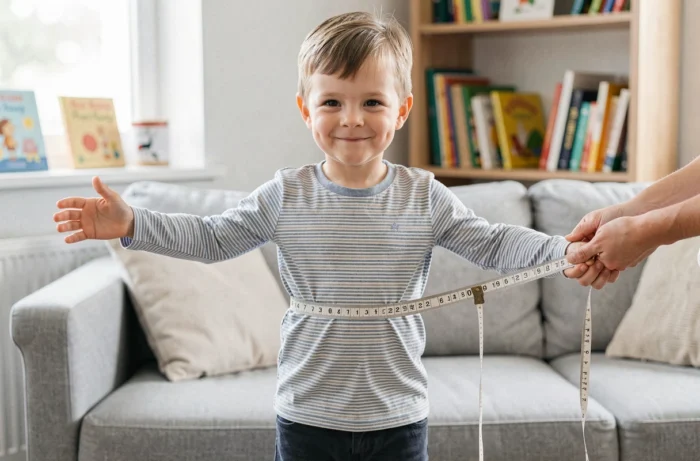
Once the measurements are taken, they need to be compared to a size chart. The table below provides standard European correspondences for children’s clothing, based on body length in centimeters (which corresponds to the number displayed on labels when they exist).
| Size (label) | Indicative body length | Approximate age | Chest circumference | Waist circumference |
|---|---|---|---|---|
| 56 | 51-56 cm | Birth – 1 month | About 40 cm | About 39 cm |
| 62 | 57-62 cm | 1 – 3 months | About 42 cm | About 41 cm |
| 68 | 63-68 cm | 3 – 6 months | About 44 cm | About 43 cm |
| 74 | 69-74 cm | 6 – 9 months | About 46 cm | About 45 cm |
| 80 | 75-80 cm | 9 – 12 months | About 48 cm | About 47 cm |
| 86 | 81-86 cm | 12 – 18 months | About 50 cm | About 49 cm |
| 92 | 87-92 cm | 18 months – 2 years | About 52 cm | About 50 cm |
| 98 | 93-98 cm | 2 – 3 years | About 54 cm | About 51 cm |
| 104 | 99-104 cm | 3 – 4 years | About 56 cm | About 52 cm |
| 110 | 105-110 cm | 4 – 5 years | About 58 cm | About 54 cm |
| 116 | 111-116 cm | 5 – 6 years | About 60 cm | About 55 cm |
The size indicated on a children’s label corresponds to the maximum body length in centimeters, not to age. A 2-year-old child who measures 90 cm fits into size 92, even if the garment is labeled “18 months – 2 years” by one brand and “2 – 3 years” by another.
Discrepancies between brands: why the same “92” doesn’t fit the same
The number on the label (when it exists) does not guarantee the same fit from one brand to another. Some brands cut their children’s clothing closer to the body, while others allow for a more generous growth margin.
In practice, a discrepancy of one to two centimeters in chest width is common between two garments of the same size, depending on the brand and cut. On a baby, this difference translates to a bodysuit that is tight around the thighs or pants with an inseam that falls too low.
This is why flat measurement is more reliable than simple chart matching. The chart provides a starting range. The actual measurement of the garment confirms or refutes this range.
- Measure the chest width of the garment laid flat and compare it to the child’s actual chest circumference divided by two.
- For pants, compare the flat-measured inseam to the child’s inner leg length (from the top of the inseam to the ankle).
- In case of doubt between two sizes, the larger size remains the safest choice: children grow quickly, and a slightly loose garment lasts longer.
Safety of cords on a children’s garment without a label
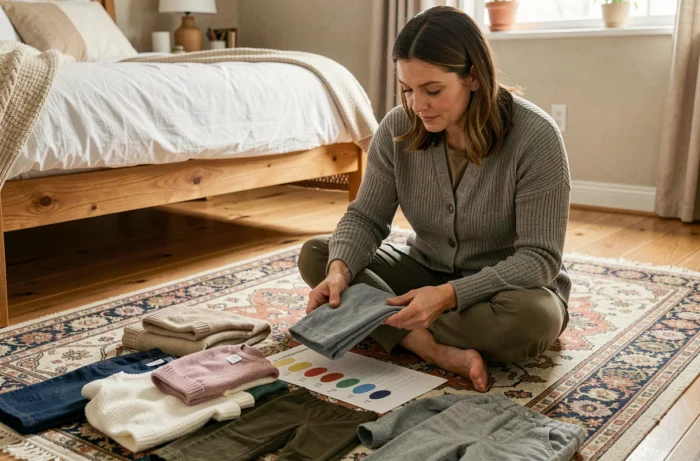
Estimating size is not the only reflex to have when faced with a children’s garment without a label. The European standard EN 14682 regulates the presence of cords and ties on clothing intended for children, particularly around the head and neck.
A product recall published in August 2026 concerned a children’s hoodie with sliding cords at the hood deemed non-compliant. The recall specified that cords at the neck must be removed or shortened before use for younger children.
On a retrieved garment without a label, it is impossible to know if it has been subject to a recall or if it complies with this standard. The verification focuses on two points:
- No free cord at the neck or hood for clothing intended for children under 7 years old.
- Cords at the bottom of the garment (waist, hem) must not exceed a certain free length to avoid any risk of snagging.
- In case of doubt about compliance, removing or sewing the cords is the most straightforward measure.
This safety check complements the size estimation. A garment that fits in dimensions but has cords that pose a risk should not be used as is.
Estimating size without a label relies on three measurable data points: garment length, chest width, and inseam. The correspondence table provides a starting point, while flat measurement clarifies. For second-hand or inherited garments, checking the cords according to the EN 14682 standard is part of the same sorting gesture as finding the right size.