A circuit breaker that trips while you’re vacuuming, a socket that heats up when you plug in the kettle: these everyday situations often reveal a deeper problem in the electrical installation. Understanding how electricity works at home starts with knowing how to read the signals your circuit sends you, and then acting before an incident occurs.
The 6 electrical safety points your home must comply with
The NF C 15-100 standard structures domestic electrical safety around six minimum requirements. These six points are not mere recommendations: they form the foundation checked during a mandatory electrical diagnosis in case of sale or rental.
- An accessible main control and protection device, meaning a main circuit breaker that each occupant can quickly turn off in case of emergency.
- At least one 30 mA residual current device associated with a functional ground, to detect current leaks before they cause electrocution.
- Protection against overcurrents on each circuit (circuit breakers rated according to the wire gauge).
- An equipotential bonding in the bathroom, which connects metallic elements (pipes, bathtub, radiator) to the ground to prevent any dangerous potential difference.
- The absence of outdated or dangerous materials, such as exposed wires, melted boxes, or non-compliant devices.
- Mechanical protection of conductors: cables must run in conduits or moldings, never exposed.
Have you ever noticed a wire coming directly out of the wall without a conduit? This is typically the sixth point that is not being respected. To delve deeper into these topics and find a qualified professional, a useful resource: https://www.electriciret.fr/.
Electrical panel and location: often ignored constraints
The electrical panel concentrates all the distribution of your house. Its location follows precise rules that go beyond simple common sense.

The panel (or the technical electrical space of the dwelling, called ETEL) must be installed away from heat sources, gas, and water points. The heights for operating the circuit breakers are regulated so that an adult can operate them without a ladder or special effort.
Why this precision about the location? Because in case of water leakage or heat emission nearby, the risk of short circuit or corrosion of connections increases. A panel placed in a damp closet under the stairs, for example, poses a concrete safety and compliance issue.
How to read your electrical panel
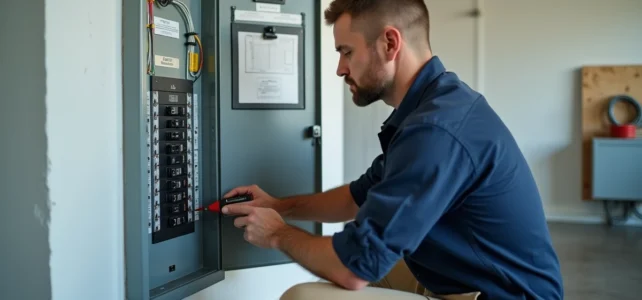
Each row of the panel corresponds to a group of circuits protected by a residual current device at the head of the line. Below, the circuit breakers individually protect each circuit: lighting, sockets, oven, cooktop, washing machine.
An overloaded circuit is identified when the same circuit breaker repeatedly trips. Before systematically resetting it, identify the responsible device by unplugging the equipment one by one. If the circuit breaker trips while empty, the problem lies in the wiring itself.
Monthly differential test: the maintenance gesture that no one does
You test your smoke detectors from time to time. Do you do the same with your residual current devices? Pressing the “Test” button on the residual current device every month allows you to verify that it cuts off the current in case of a leak. This gesture takes five seconds.
If the residual current device does not trigger during the test, it no longer protects you. Replacement must be immediate. A faulty residual current device allows leakage currents to pass to the ground, meaning that contact with a defective device can cause electrocution without anything cutting off the circuit.

Type A or type AC residual current device
The type AC detects classic alternating current leaks. The type A additionally detects direct current components, produced by certain devices such as induction cooktops or washing machines. The standard requires a type A residual current device on the kitchen and washing machine circuit.
Placing a type AC on these circuits does not necessarily trigger a visible anomaly but reduces actual protection. This is a common flaw in partially updated old installations.
Electrical sockets, power strips, and overload: common mistakes
Plugging one power strip into another (the infamous “daisy chaining”) is one of the frequent causes of overheating. Each wall socket is connected to a circuit sized for a maximum current. Stacking devices on a single connection point exceeds this capacity.
A socket that feels warm to the touch indicates an overload or a poor connection. Immediately unplug the affected device. A loose connection at the back of the socket is enough to create a hot spot capable of melting plastic.
Proximity of water and electricity in the bathroom
The bathroom is divided into safety volumes (0, 1, 2, and outside volume). The closer you get to the bathtub or shower, the stricter the restrictions on electrical devices. In volume 0 (inside the bathtub), no electrical devices are allowed. In volume 1, only equipment powered by very low safety voltage is permitted.
The equipotential bonding mentioned earlier makes perfect sense here: it prevents a potential difference between a faucet and a radiator from turning your bathroom into a trap.
Power outages and power return: protecting your devices
After a prolonged outage (storm, network work), the return of power can generate a brief surge. Sensitive electronic devices, computers, internet boxes, televisions, are vulnerable to this.
A surge protector installed in the panel protects the entire home from these voltage spikes. In areas often struck by lightning, its installation is actually mandatory according to the NF C 15-100 standard.
In case of a power cut, first check if the problem comes from your installation (tripped circuit breaker) or the network. If your neighbors are also affected, the network manager handles the restoration. If you are the only one affected, examine your panel before restoring power.
A well-designed domestic electrical circuit is not just wires in the walls. Each component, from the 30 mA residual current device to the surge protector, serves a specific protective function. The most useful gesture remains the simplest: test your residual current device once a month and never ignore a socket that heats up.