
Working from home in 2024 involves solving concrete problems: isolation, time management, ergonomics, and separating professional and personal life. Here are ten operational practices that directly influence productivity and the sustainability of remote work, regardless of status (employee in telecommuting, freelancer, or self-employed).
1. Set fixed time slots with disconnection periods

The stabilized hybrid model in France revolves around two days a week at home according to Insee. This regularity facilitates the establishment of consistent hours, but it is not enough.
Setting a start time and an end time protects against the insidious stretching of the day. La Croix noted that telecommuting creates a form of symbolic debt of the employee to the employer, pushing to work beyond contractual hours. Specific time slots communicated to the team reduce this risk.
Several resources compiled on travailler-chez-soi.org detail planning methods suited to different statuses, from part-time telecommuting employees to full-time freelancers.
2. Arrange a workspace physically separate from the rest of the home
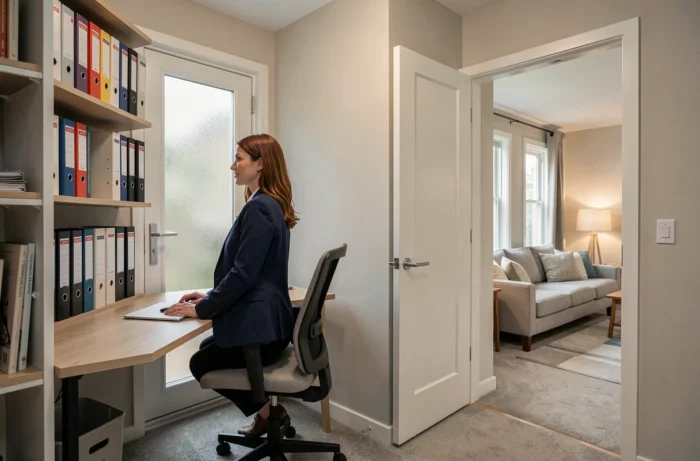
A desk set up in the bedroom or on the kitchen table blurs the boundary between work and rest. Ideally, a closed room is best, but a simple screen or a tall shelf is enough to create a visual break.
The issue is also fiscal: self-employed individuals and freelancers can, under certain conditions, deduct a portion of expenses related to the professional use of their home. Having an identifiable space strengthens the legitimacy of this deduction in case of an audit.
3. Invest in ergonomic equipment suitable for prolonged work

An external monitor, a separate keyboard, and an adjustable chair are not just comfort accessories. They are tools that prevent musculoskeletal disorders. Working on a laptop placed on a coffee table for months leads to documented neck and lower back pain.
The table below compares priority spending items according to the type of activity:
| Item | Sedentary job (writing, data, accounting) | Job with frequent video conferences |
|---|---|---|
| External monitor | High priority | High priority |
| Micro/headset | Low priority | High priority |
| Ergonomic chair | High priority | High priority |
| Supplementary lighting | Medium priority | High priority (camera framing) |
| Second screen | High priority | Medium priority |
4. Use the Pomodoro method to maintain concentration

Working from home exposes one to constant domestic interruptions. The Pomodoro technique (25 minutes of focused work, 5 minutes of break) imposes a framework that limits distraction.
Four Pomodoro cycles represent about two hours of effective work, often more productive than four continuous hours interrupted by distractions. The tool does not need to be sophisticated: a kitchen timer serves the purpose.
5. Plan tasks the night before to avoid the “blank page” effect

Without colleagues or a morning meeting to structure the start of the day, the risk of procrastination increases. Preparing a list of three to five priority tasks the night before eliminates the floating time at the start.
This practice works better than a to-do list written in the morning because it engages the brain in execution rather than planning when energy is at its peak.
6. Separate professional and personal digital tools
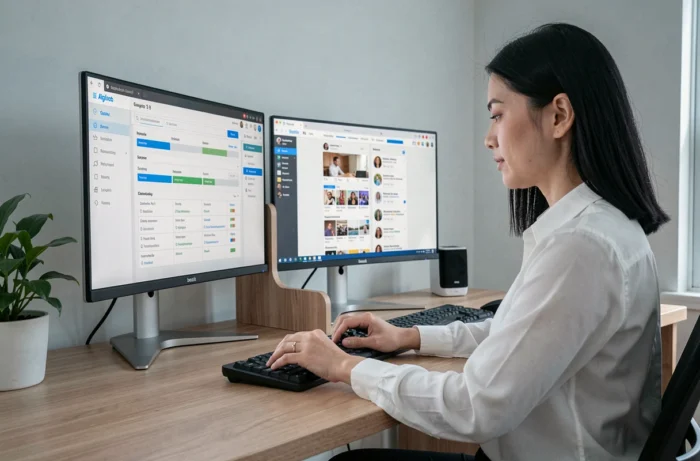
Using the same browser, email account, or profile for work and personal life creates permanent interferences. Personal notifications during work hours (and vice versa) fragment attention.
Creating a dedicated work browser profile allows for compartmentalizing bookmarks, extensions, and connected sessions. Some go further by using a distinct operating system via a partition or a second user account.
7. Maintain regular professional social interactions

Isolation is the primary factor for abandoning remote work over time. Nearly three-quarters of French employees never telecommute, meaning that the regular telecommuter often finds themselves out of sync with their professional environment.
Scheduling at least one weekly video conference with the team and participating in online communities related to one’s profession mitigates this effect. For freelancers, occasional coworking spaces (once or twice a month) provide a useful counterbalance.
8. Frame family interruptions with explicit rules
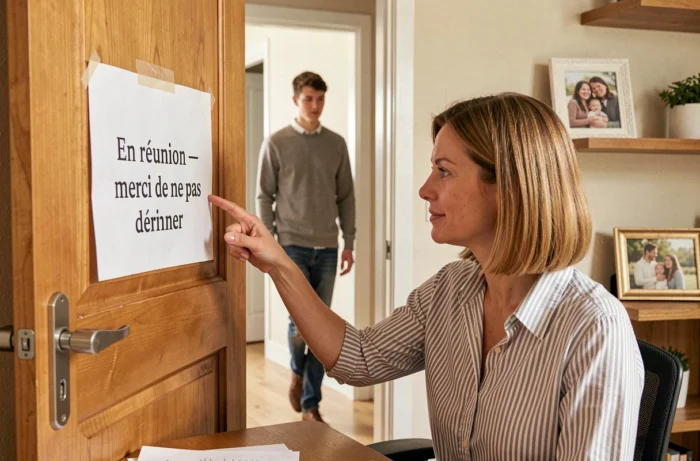
Working from home with children or a partner present requires clear rules. A physical signal (closed door, headphones on) works better than a verbal agreement repeated every day.
Unplanned interruptions reduce productivity well beyond their actual duration, because the time to refocus after each break counts in minutes. Setting visible “available” and “unavailable” slots for the household decreases the frequency of these interruptions.
9. Verify the reliability of work-from-home offers before committing

Scams related to work-from-home opportunities are increasing. Fake offers circulated on social media promise unrealistic pay, while some companies issue fake pay slips without declaring employees to Urssaf.
Three minimum checks before accepting a remote mission or job:
- Check the company’s SIRET number on the official commercial register website
- Refuse any offer that requires an upfront payment, regardless of the reason given
- Prefer recognized platforms (Malt, LinkedIn, ComeUp) over ads on social media
10. Automate repetitive administrative tasks
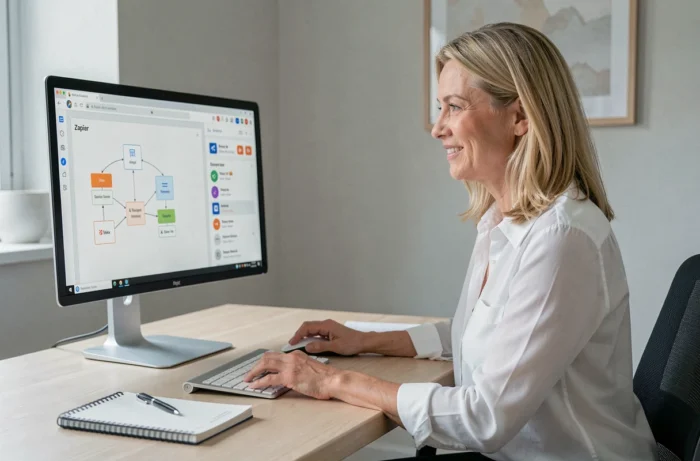
Invoicing, client follow-ups, document filing, revenue declarations: these tasks consume a disproportionate amount of time when managed manually. Automated invoicing tools and pre-filled document templates free up several hours per month.
For self-employed individuals, automating revenue declaration via Urssaf reminders prevents forgetfulness and penalties. Freelancers in wage portage already benefit from this outsourced management, which is a rarely highlighted argument for this status.
Working from home relies less on the choice of profession than on the ability to structure one’s environment and habits. An ergonomic workstation, set hours, and well-separated tools contribute more to the longevity of the arrangement than an activity theoretically compatible with home.