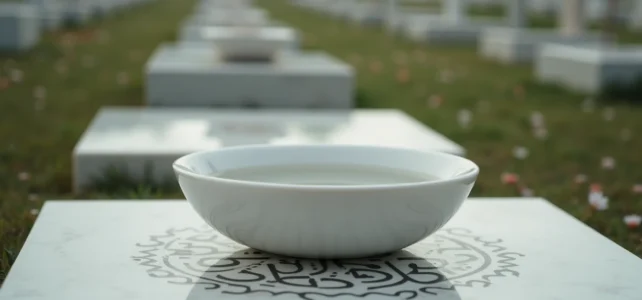
When visiting a Muslim cemetery, you may have noticed a small bowl of water placed on certain graves. This discreet and repetitive gesture intrigues both visitors and the faithful themselves. It is not a Quranic obligation, but a custom passed down from generation to generation, especially in the Maghreb. Understanding this bowl of water on Muslim graves means tracing the thread of a heritage where spirituality, symbolism of water, and solidarity towards living beings intertwine.
Water and purification in the Muslim funeral ritual
Even before burial, water occupies a central place. The deceased receives funeral ablutions, a ritual washing of the body that symbolizes purity. This gesture is one of the first duties of the community towards the one who has just died.
The body is then wrapped in a white shroud, without a coffin in the strictest tradition. It is placed directly on the ground, lying on its right side, with the face oriented towards Mecca. Water also comes into play at this moment: the freshly turned earth is sprinkled to compact it and prevent the wind from scattering it.
This sprinkling during the burial is the only water-related practice at the grave that is agreed upon by Muslim scholars. Everything that follows, including the bowl of water, is a cultural practice rather than a religious prescription. To delve deeper into the meaning of the bowl of water on Muslim graves, one must distinguish what the Quranic text says from what popular custom has constructed around this gesture.
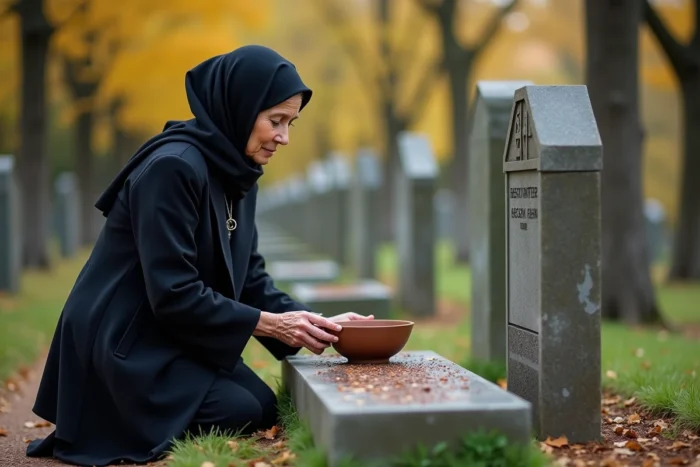
Bowl of water on graves: a Maghreb custom, not an obligation
You may be wondering if this bowl of water is mentioned in the Quran or the hadiths. The answer is no. No canonical text prescribes leaving water on a grave after burial.
This practice is primarily observed in Maghreb countries and among Maghreb communities in France. The most widespread idea is simple: the bowl allows birds and small animals to quench their thirst. Every living being that drinks this water would generate hassanates (spiritual rewards) for the benefit of the deceased.
This reasoning is based on the concept of sadaqa jariya, the continuous charity. In Islam, certain good deeds continue to benefit a person after their death. Planting a tree, digging a well, passing on useful knowledge: these gestures produce lasting benefits. The bowl of water fits into this logic, even if no hadith explicitly mentions it.
What scholars say
Several religious authorities view this practice with caution. Sheikh Uthaymin, a recognized Saudi scholar, explained that putting water on graves does not benefit the deceased in any way. According to him, anyone who does so believing otherwise is mistaken.
The hadith reported by Al Hassan Ibn Ali supports this view: “Leave what makes you doubt for what does not make you doubt.” This principle encourages the faithful to steer clear of practices whose religious foundation is uncertain.
The bowl of water is neither forbidden nor recommended, but it exists in a gray area that each believer interprets according to their sensitivity and family tradition.
Symbolism of water in Muslim funeral traditions
Beyond its practical aspect, water carries a strong symbolic weight in Islamic culture. The Quran presents it as the source of all life. It evokes divine mercy, purification, and renewal.
Sprinkling a grave is, in popular imagination, a way to keep the memory of the deceased “fresher” in people’s minds. The expression may seem naive, but it reflects a deep need: to maintain a living connection with the one who has departed. The water that evaporates under the sun reminds us of the fragility of earthly life, while the act of pouring it expresses the continuity of affection.
In some families, filling the bowl with water at each visit to the cemetery has become a ritual in its own right. It structures the moment of remembrance, providing a concrete gesture to perform, somewhat like flowers in the Christian tradition.
Flowers or water: two approaches to remembrance
You may have also noticed that Muslim graves rarely have flowers. Flowers are not forbidden in Islam, but they are considered superfluous by the majority of scholars. The simplicity of the Muslim burial is an important principle.
- The bowl of water serves a utilitarian function (watering animals) while also carrying a spiritual dimension, making it more coherent with tradition than purely decorative ornaments.
- Flowers, associated with Western funeral rites, are sometimes seen as an imitation of another culture, which some believers prefer to avoid.
- Reading the Quran and giving charity in the name of the deceased remain the most unanimously recommended acts to honor the memory of a loved one.
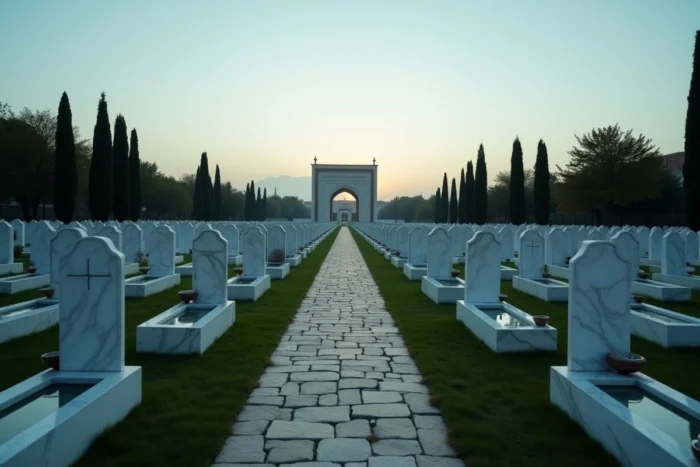
Muslim squares in France: a context that changes practices
The question of the bowl of water arises differently depending on where the grave is located. In France, public cemeteries host confessional groupings, often referred to as “Muslim squares.” In recent years, several large urban areas have evolved these spaces into open groupings, integrated into the rest of the cemetery.
This organization concretely changes the environment of the graves. Muslim graves are next to those of other faiths. The movement of visitors, as well as animals, is freer. A bowl of water placed in an open cemetery has a different significance than one placed in a closed and rarely visited square.
Funeral homes specializing in Muslim rites now assist families with these practical questions: orientation of the grave, burial timelines, respect for local customs. The professionalization of the sector helps to articulate customary practices with the French regulatory framework.
- The internal regulations of each cemetery determine what can be placed on a grave, including a water container.
- Some municipalities allow small objects, while others remove them during periodic maintenance.
- In case of doubt, families can inquire with the municipal funeral service before placing anything.
The bowl of water on a Muslim grave tells in a few centiliters a whole worldview: the earth that welcomes the body, the water that nourishes the living, and the hope that even a tiny gesture can still connect those who remain with those who have departed. Whether seen as a family tradition or an act of faith, it reflects an attention to the deceased that transcends the categories of what is permitted and forbidden.