
The animated video is taking an increasingly prominent place in the communication budgets of French companies. According to a report published by Clakprod, motion design will become a strategic pillar of communication plans by 2026, conceived as a storytelling tool integrated into campaigns and internal devices, rather than as a one-off decoration. This shift from decorative to structural merits an examination of how this format concretely changes the way a company conveys its messages.
Motion design and cognitive load: a memorization challenge, not an aesthetic one
Motion design does not derive its value from its colors or smooth transitions. Its main strength is cognitive.
According to Pantome, the challenge of applying motion design to data is not aesthetic but cognitive. Movement directs attention, progressive construction creates anticipation, and visual resolution anchors the number or message in memory. This mechanism explains why a well-constructed animation facilitates the retention of a complex message where a static PDF or a traditional slideshow fails.
In corporate communication, this translates into a usage that goes beyond simple promotion. Presenting an annual report, explaining an internal reorganization, simplifying a technical process: motion design structures information into visual sequences that guide the viewer’s gaze. The viewer does not choose where to focus their attention; the animation does that for them.
To better understand the reasons for choosing a motion design video in a professional context, one must first accept that the question is not “is it pretty?” but “does my audience retain the message?”.
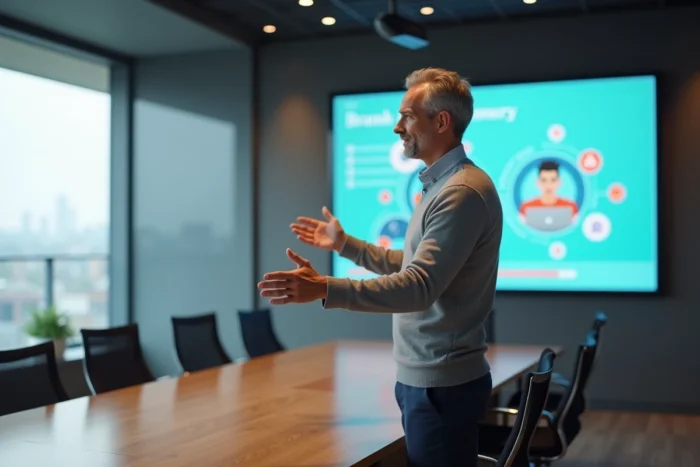
Internal communication: the area where animated video truly changes the game
Competing articles address motion design almost exclusively from the perspective of external marketing (social media, advertising, product presentation). However, internal communication represents a rapidly growing application area.
Canalchat documents an expanding usage: motion design is used to clarify sensitive decisions, harmonize managerial messages, and facilitate the adoption of new processes by teams. A two-minute video sent to all employees replaces a three-page email that no one reads to the end.
Concrete internal use cases
- Announcement of an organizational change or merger of departments, where the message must be understood in the same way by all employees, regardless of their hierarchical level
- Deployment of new IT tools or quality processes, with visual steps replacing a user manual
- Presentation of quarterly financial results, where numerical data gains readability through the progressive animation of graphs
The gain is not only in clarity. A well-scripted internal video reduces the number of post-broadcast questions, freeing up time for managers and HR teams.
Script and storyboard: where the project’s success is determined
A common reflex is to judge a motion design video by its animation quality. Field feedback shows that projects that fail do not suffer from a graphic flaw but from a script problem.
The script defines the narrative structure: which message comes first, how the arguments flow, when the voiceover comes in, what information remains on screen and for how long. The storyboard translates this script into visual sequences before any animation is produced.
What distinguishes an effective brief
A useful brief does not simply describe the company. It answers three specific questions: who is the video aimed at, what behavior should it provoke in the viewer, and on what platform will it be distributed. A motion design intended for LinkedIn does not have the same duration or rhythm as a video projected in a plenary meeting.
The optimal duration depends on the distribution context. On social media, short formats capture attention better. For an explanatory video intended for a management committee, a longer duration is justified if each second provides new information. The format must serve the objective, not the other way around.

Budget and provider: what quotes do not always show
The cost of a motion design video varies significantly depending on graphic complexity, duration, number of revisions, and the level of client involvement in the scripting phase. Quotes generally display a total price, but the distribution of work time among the stages deserves attention.
The design phase (script, storyboard, artistic direction) often represents a significant portion of the total budget. Reducing this phase to save money almost always leads to costly corrections during the animation phase. Validating a solid storyboard before launching production remains the best way to control the final budget.
Agency, studio, or freelancer
The choice of provider depends on the volume of production and the level of support expected. An agency typically offers comprehensive project management, from the brief to delivery. A freelance motion designer offers more pricing flexibility but often requires the client to provide a structured brief and a pre-written script.
The available data does not allow for a conclusion that one model is systematically superior to another. The determining criterion remains the provider’s ability to understand the company’s message and translate it into a coherent visual narrative.
Motion design has ceased to be a tool reserved for high-budget advertising campaigns. Its adoption in internal communication, training, and data presentation marks a change in usage that now concerns companies of all sizes. The preparatory work (brief, script, validated storyboard) conditions the project’s success at least as much as the quality of the final animation.