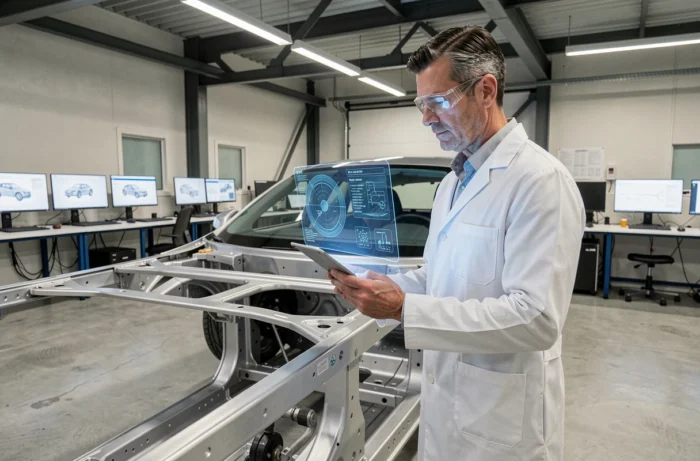
Your car receives a software update overnight, just like a smartphone. By morning, the emergency braking system detects pedestrians more accurately than before. This scenario, still rare two years ago, is becoming standard for several manufacturers in 2024. The technological innovations transforming the automotive industry are no longer limited to engines or batteries: they now also encompass software, cybersecurity, and the very design of vehicles.
Automotive Cybersecurity: A Legal Requirement Since July 2024
Before discussing autonomous driving or next-generation batteries, a major regulatory change is reshaping the rules of the game. Since July 2024, UN regulations R155 and R156 have become a legal requirement for the approval of a new vehicle in over 60 countries, including the entire European Union, Japan, South Korea, and Australia.
Specifically, regulation R155 requires each manufacturer to prove that it manages the cybersecurity of its vehicles throughout their lifecycle. R156, on the other hand, governs software updates: every modification, whether sent remotely (OTA) or performed in a workshop, must be documented and cannot jeopardize the vehicle’s approval.
A modern connected car contains several tens of millions of lines of code. Without a strict framework, a simple update could alter the behavior of a braking or driving assistance system without verification. Manufacturers must now document every software intervention, a colossal task that mobilizes entire teams of engineers.
Players closely monitoring these developments, such as those referenced on https://www.automotech.fr/, help to better understand the scope of this transformation.
In parallel, the United States published a federal rule in September 2024 banning the import of connected vehicles that integrate software from entities linked to China or Russia in their critical systems (connectivity, automated driving, data-transmitting sensors). China responded in February 2025 with its own validation requirements for security-related OTA updates.
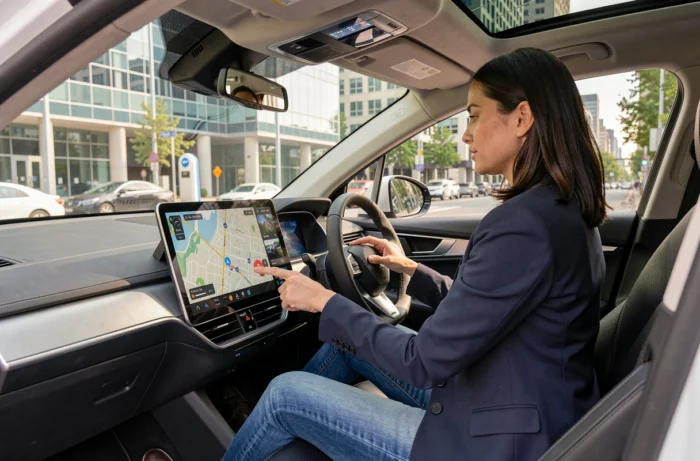
Software-Defined Vehicle: What the Shift to Software-Defined Vehicle Means
You may have noticed that the options in your car can now be activated after purchase, via a subscription or a one-time payment? This is the principle of the software-defined vehicle, or software-defined vehicle (SDV).
The idea is simple: the hardware is installed at the factory, but it is the software layers that determine the available features. The same vehicle can thus evolve throughout its lifespan, receive new driving assistance functions, or improve its infotainment system without going to a workshop.
This approach profoundly changes the business model of manufacturers. The sale of the vehicle is no longer the only source of revenue: paid updates, subscriptions to connected services, and remote performance enhancements create a continuous stream. For the driver, this means that a model purchased today can gain capabilities in two or three years, provided the manufacturer maintains software support.
Centralized Architecture and Multi-Domain Chips
To make this possible, manufacturers are replacing dozens of separate controllers (one for the engine, one for braking, one for air conditioning) with multi-domain chips capable of managing multiple functions simultaneously. This centralized architecture reduces wiring, simplifies updates, and allows for easier integration of artificial intelligence into the vehicle.
Generative Artificial Intelligence in Automotive Design
Generative AI does not just write texts. Applied to automotive design, it allows for testing thousands of variants of a mechanical part in a few hours, where an engineer would take weeks. Generative design algorithms propose optimized shapes according to specific constraints: minimal weight, shock resistance, compatibility with existing manufacturing processes.
- Several manufacturers are integrating AI into the digital cockpit to adapt the display and driving recommendations to the driver’s behavior in real-time.
- Vehicle development cycles are significantly shortened thanks to AI-driven simulations, reducing the number of physical prototypes needed.
Generative AI compresses automotive R&D cycles, enabling manufacturers to launch models more quickly while testing more configurations. The gain is not only in speed: the quality of the proposed solutions often exceeds what a human engineering office would produce alone, because the algorithm explores geometries that no one would have considered.
Batteries and Charging: Alternatives to Conventional Lithium-Ion
Sodium-ion batteries are beginning to appear in production models, particularly in the Chinese market. Their main advantage: they do not use cobalt or lithium, two materials whose extraction poses environmental and geopolitical issues. Their energy density remains lower than that of lithium-ion, but it is sufficient for urban compact cars with moderate range.
Sodium-ion batteries reduce dependence on critical materials and their production cost is lower. For European manufacturers, this technology could offer an accessible electric mobility solution, without relying on supply chains concentrated in a few countries.
On the charging side, infrastructure continues to develop, but the high purchase costs of electric vehicles remain a barrier for many consumers. Plug-in hybrid solutions therefore retain their relevance as a transition to fully electric.
LiDAR Sensors and Autonomous Driving: Where Do We Really Stand?
LiDAR technology is gaining precision and miniaturization. Current sensors generate detailed 3D maps of the environment, allowing assisted driving systems to detect and classify objects with increasing reliability.
- The resolution of LiDAR sensors has progressed to the point of distinguishing a pedestrian from a pole several dozen meters away.
- The combination of LiDAR, cameras, and radar (sensor fusion) improves the robustness of advanced driver assistance systems in degraded weather conditions.
- AI-driven scene reconstruction techniques accelerate simulation, reducing the need for millions of kilometers of real-world testing.
Fully autonomous Level 5 driving remains a distant goal. Concrete progress mainly concerns Levels 2 and 3, where the driver retains a supervisory role. Regulation is advancing more slowly than technology, and it is often regulation that determines the actual deployment timeline.
The automotive industry in 2024 is transforming as much through code as through mechanics. Manufacturers that master cybersecurity, embedded software, and design AI are gaining a competitive edge, while international standards impose a framework that no one can ignore.