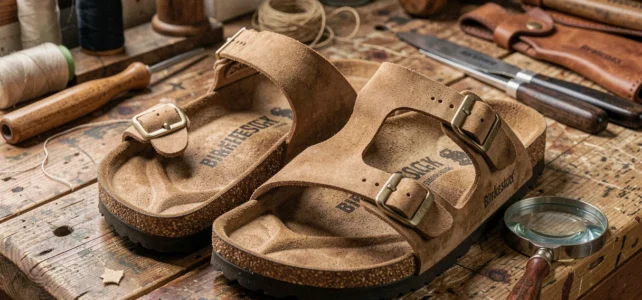
An authentic Birkenstock is distinguished by precise construction details that are reproducible from one model to another: markings on the buckles, anatomical imprint of the footbed, engraving on the outsole. Recent counterfeits are getting better at copying the overall appearance, but still fail on these micro-details of shape and materials.
Birkenstock Footbed: the area that counterfeits imitate the least well
The footbed is the most reliable control point for distinguishing a genuine pair from a copy. On an authentic model, the footbed features three distinct functional zones: a deep heel cup, a marked arch, and a raised metatarsal support.
Recent counterfeits replicate the color and surface texture of cork quite well. However, the alignment of the arch and the depth of the heel cup remain difficult to imitate accurately. On a fake pair, the footbed appears flatter, the transition between zones is less defined, and the cork may seem uniformly smooth instead of having a slight irregular grain.
To check this point, run your thumb over the arch area: on an authentic pair, the relief is firm and well-defined. On a copy, it flattens or distorts under light pressure. This tactile difference is more telling than any quick visual examination.
A detailed guide allows you to avoid Birkenstock counterfeits with Caro Bleue Violette by comparing photo by photo each area of the footbed.

Markings and buckles: where the name Birkenstock should appear
On an authentic pair, the name BIRKENSTOCK is printed in three distinct locations. This redundancy in marking serves as an anti-counterfeiting lock, as faithfully reproducing the three locations complicates the copying process.
- On the metal buckles: the name is engraved in relief, with clear and regular letters. On a counterfeit, the engraving is often raised, too thick, or slightly misaligned with the center of the buckle.
- On the insole, at the footbed level: an imprint representing a foot bone accompanies the logo. The absence of this anatomical imprint almost always indicates a copy.
- On the outsole (bottom of the shoe): the name and model are molded into the rubber. The letters should be legible without effort, with sharp edges.
If any one of these three markings is missing or has a different typography from the other two, the pair is suspect. Counterfeiters often neglect the outsole, which requires a specific mold that is costly to reproduce.
Box and label: clues that sellers do not check
The packaging provides additional clues, especially when purchasing online. Counterfeits often stumble over the information on the box rather than the shoe itself.
An authentic Birkenstock box displays the exact model (Arizona, Boston, Madrid), the size, the width of the foot (regular or narrow), and a barcode. Buyer feedback regularly reports inconsistencies on counterfeit boxes: size indicated does not match the pair, model name misspelled, or absence of width mention.
One point to note: Birkenstock does not place an individual serial number on each pair. Identification is done through packaging and molded markings, not through a unique code on the shoe. If a seller highlights an “exclusive serial number” engraved on the sole, it is paradoxically a warning signal.
The trap of online marketplaces
A significant number of “new” listings on major marketplaces feature suspect pairs, sold at prices significantly lower than usual. The abnormally low price remains the most immediate indicator. An Arizona or Boston sold at half the catalog price without justification (official clearance, old collection) deserves thorough verification before purchase.
Materials and finishes: leather, cork, and rubber sole
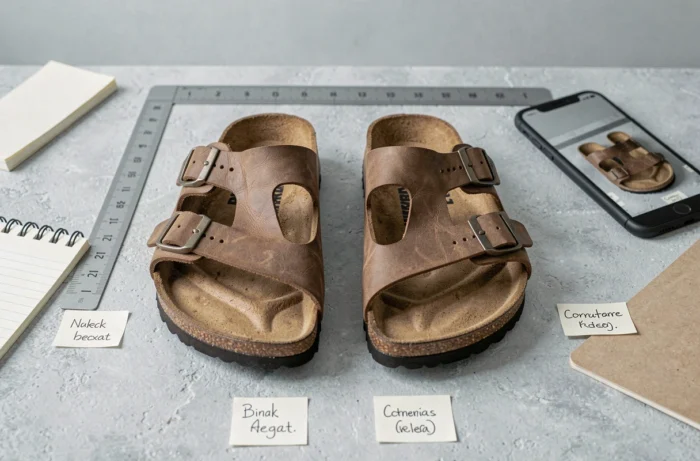
Beyond the markings, the materials used by Birkenstock have characteristics that are difficult to reproduce at low cost.
The cork of the authentic footbed is mixed with natural latex, giving it a progressive flexibility: rigid upon unpacking, it molds to the foot after a few days of wear. Copies often use synthetic cork or a composite that remains hard or, conversely, crushes too quickly without returning to its shape.
On leather models like the Boston, the quality of the leather can be verified by touch and smell. Birkenstock leather emits a characteristic tanning odor, whereas the faux leather of counterfeits smells like plastic or solvent. The surface of authentic leather shows slight natural irregularities (grain, color variations), unlike faux leather, which is too uniform.
The EVA outsole of authentic models offers controlled flexibility. When gently bending the shoe, the sole should resist and then return to its original shape. A sole that bends without resistance or cracks indicates a lower quality material.
Buying authentic Birkenstocks: reliable channels
The most direct way to guarantee authenticity is to purchase from the official Birkenstock website or from authorized retailers identifiable on the brand’s site. Recognized multi-brand physical stores also constitute a safe channel, as they source through the official distribution network.
For second-hand purchases or on third-party platforms, checking the three marking points (buckles, insole, outsole) combined with examining the footbed covers the majority of common counterfeiting cases. These checks take less than a minute and eliminate the most blatant copies, which still represent the bulk of the Birkenstock counterfeit market.