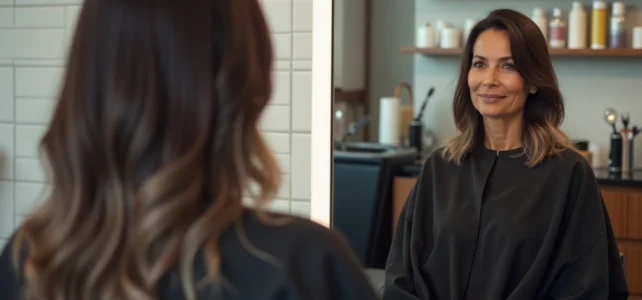
Grey blending on a brown base poses technical constraints that classic balayage does not resolve. The presence of dense eumelanin pigments in the fiber, often coupled with a history of repeated colorings, requires a fractional bleaching protocol to avoid orange or coppery tones. Here, we detail the fine points that condition the success of this transition on brown hair.
Fractional bleaching on a brown base: why single balayage fails
On a natural or colored brown base, a single-session balayage almost always produces unwanted warm highlights. Eumelanin, the dominant pigment in dark hair, releases orange and copper undertones as the oxidizing product degrades the keratin.
We observe that specialized colorists now favor progressive lightening with baby-lights or very fine weaves rather than wide balayage. This fractionation limits the mechanical breakage of the fiber and allows for gradual lightening session by session, without ever exposing the hair to prolonged processing times.
The hair history complicates matters further. Years of layered dark dyes create an artificial “layer cake” of pigments that the oxidant penetrates unevenly. Henna, in particular, forms an almost impermeable sheath around the fiber: any attempt to bleach over henna risks a greenish shift or a sharp breakage of the hair. Understanding the grey blending transition on brown first requires a precise diagnosis of this history before touching a single brush.
The protocol is therefore divided into several appointments spaced a few weeks apart, each session targeting a different area or depth level. This approach extends the total duration of the transition, but it preserves the integrity of the hair and ensures a homogeneous blend between the natural white strands and the still pigmented lengths.
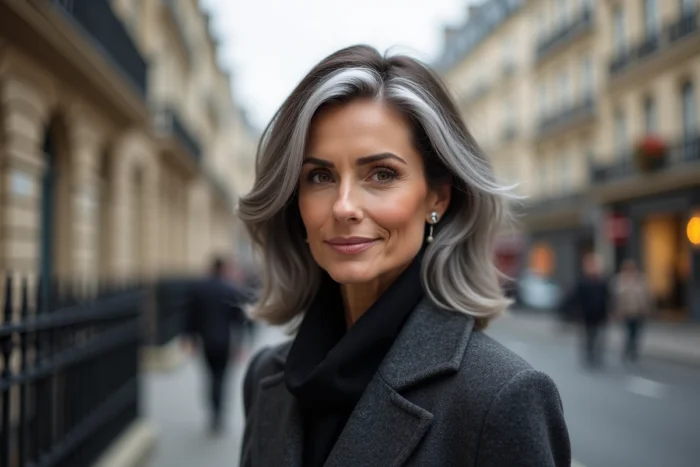
Brown grey blending: chair time and technical reality in the salon
Grey blending services on brown hair are among the longest in the salon. Several colorists report sessions occupying five to seven hours in the chair, including diagnosis. This time is explained by the finesse of the work: each strand is calibrated to reproduce the salt-and-pepper appearance of the roots throughout the hair.
The initial diagnosis conditions everything else. The colorist evaluates three parameters:
- The percentage of white hair already present, which determines the density of strands to lighten for a credible blend.
- The condition of the fiber (porosity, elasticity, thickness), measured by a simple stretch test, which sets the volume of oxidant and the maximum processing time.
- The exact color history, including products used at home, which guides the choice between classic bleaching and less aggressive acidic products.
A successful grey blending on brown is not just a simple grey balayage. It is a progressive color correction service, requiring a fine reading of the material and a sense of the salt-and-pepper contrast that standard balayage does not address.
Managing the roots-lengths demarcation line
The classic trap on a brown base remains the sharp demarcation between the white regrowth and the still dark lengths. Grey blending circumvents this problem by placing the lightened strands very close to the root, with a variable thickness that mimics the natural dispersion of white hair.
We recommend concentrating the finest weaves on the frontal area and the temples, where the first whites appear and where the eye immediately detects the contrast. The occipital areas, less visible, receive a more spaced treatment. This deliberate asymmetry yields a natural result that classic symmetrical balayage does not replicate.
Maintenance of grey blending on brown hair: products and frequency
The maintenance of grey blending on brown is significantly less demanding than a classic coloring, but it is not nonexistent. The lightened strands, deprived of some of their pigment, tend to yellow due to oxidation, pollution, and minerals in the water.
A purple pigment shampoo used once a week is sufficient to neutralize these warm highlights. However, daily use would turn the strands towards an artificial bluish grey. The ideal frequency is between one and two uses per week, alternating with a gentle sulfate-free shampoo.
In the salon, the regrowth on a brown base remains discreet much longer than with a full color. The gradual blend between the natural whites and the lightened strands visually absorbs the regrowth for several weeks. Most clients space their touch-up appointments much more than with traditional color.
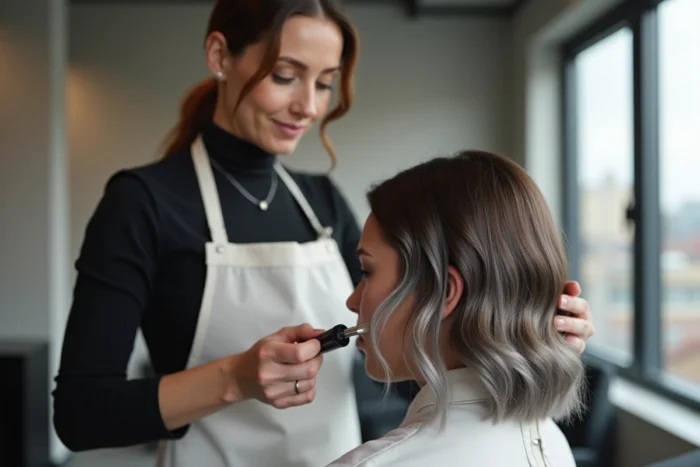
The psychological dimension of the grey blending transition for brunettes
Colorists specializing in the transition to white report a recurring phenomenon: their brunette clients describe grey blending as a lever for the progressive acceptance of white hair. The abrupt cessation of coloring often causes a visual shock, a sharp break between the projected image and the perceived reflection.
Grey blending acts as a buffer. The client sees her white hair gradually integrate into a coherent whole, without ever experiencing the violent contrast between white regrowth and dark brown lengths. This process demystifies greyness and transforms a constraint into an assumed choice.
These field reports, widely documented by before/after photos published by colorists on social media, remain almost absent from editorial articles on the subject. The technique is not just a coloring gesture: it alters the relationship to the appearance of white hair itself, making the transition visible without being abrupt.
The success of grey blending on brown relies on a rigorous diagnosis, a fractional protocol, and a colorist trained in this specific service. Choosing a professional who regularly publishes their results on brown bases, with photos taken in natural light, remains the most reliable filter to avoid disappointments.