
When writing an email to a Spanish-speaking partner or preparing for a DELE certification, the verb ser appears in almost every sentence. The problem is that its forms are irregular in nearly all tenses. Understanding the conjugation of the verb ser in Spanish allows for the construction of solid sentences from the beginner level and helps avoid recurring confusion with estar.
Ser in the present indicative: the irregular forms that trap French speakers
The present tense is where ser poses the most difficulties, as none of its six forms resemble the infinitive. Neither the root “ser-” nor a regular pattern comparable to -er verbs can be found.
To delve deeper into each form and access exercises categorized by level, a practical sheet on the conjugation of the verb ser in Spanish helps structure revisions effectively.
| Person | Form | Common example |
|---|---|---|
| Yo | soy | Soy francés (I am French) |
| Tú | eres | Eres estudiante (You are a student) |
| Él / Ella / Usted | es | Es médico (He/She is a doctor) |
| Nosotros | somos | Somos compañeros (We are colleagues) |
| Vosotros | sois | Sois muy amables (You are very kind) |
| Ellos / Ustedes | son | Son de Argentina (They are from Argentina) |
The most common mistake among French-speaking learners is confusing soy (permanent identity) and estoy (temporary state). “Soy cansado” does not exist in everyday Spanish: fatigue is a temporary state, so we use estar.
To anchor these forms, it is recommended to memorize “chunks,” that is, fixed blocks of words: soy de, es un, somos los. Frequency studies on spoken Spanish confirm that ser appears massively in these copula + noun or copula + adjective combinations, making it a very efficient memorization tool.
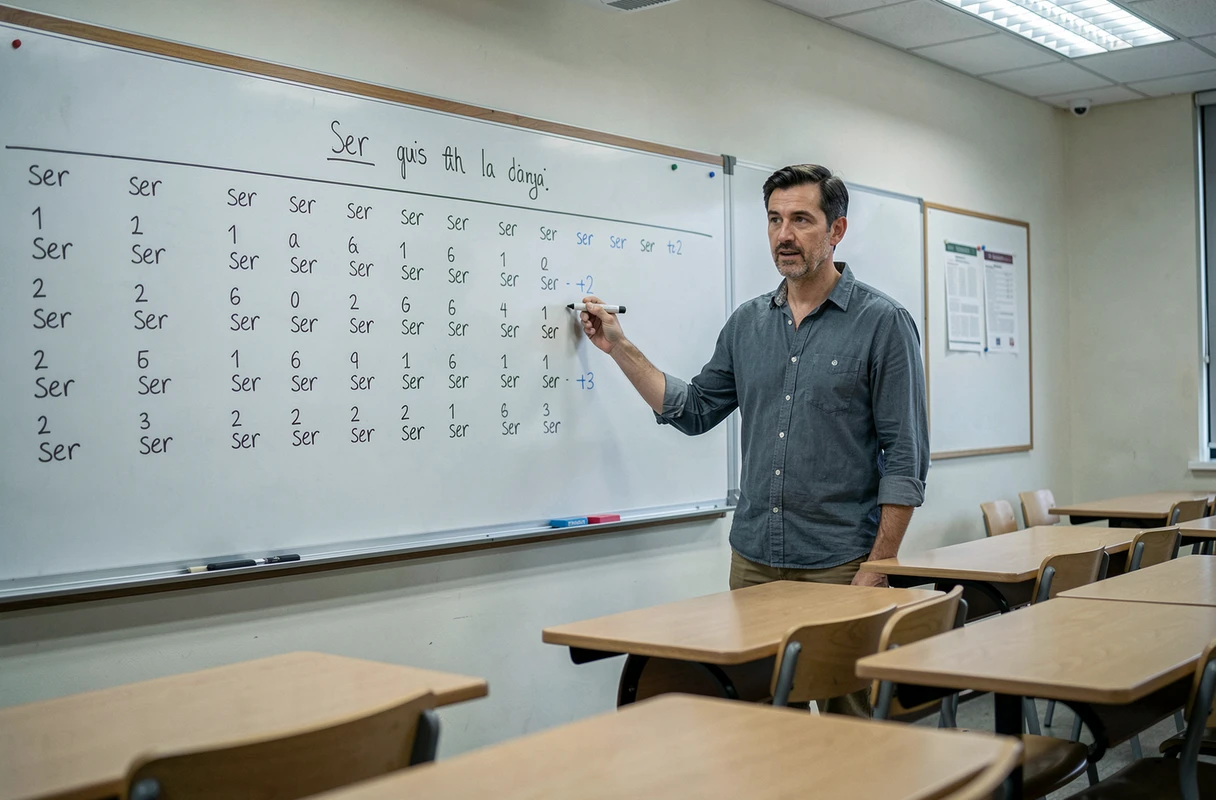
Simple past and imperfect of ser: two tenses, two logics
We often find ourselves stuck when we need to recount an anecdote in the past. Ser radically changes form in the simple past (pretérito indefinido) and even shares its conjugations with the verb ir. This is a classic trap in exams.
Pretérito indefinido: fui, fuiste, fue
The simple past forms of ser are identical to those of ir. Only the context allows us to distinguish the two verbs. “Fue médico” means “he was a doctor” (ser), while “fue a Madrid” means “he went to Madrid” (ir).
| Person | Form |
|---|---|
| Yo | fui |
| Tú | fuiste |
| Él / Ella | fue |
| Nosotros | fuimos |
| Vosotros | fuisteis |
| Ellos | fueron |
None of these forms carry a written accent on fue or fui. This is a spelling peculiarity to remember, as many learners reflexively add an accent.
Imperfect: era, eras, era
The imperfect of ser is more regular: era, eras, era, éramos, erais, eran. It is used to describe lasting past characteristics. “Era profesor en Sevilla” describes a situation that stretched over time, without a precise boundary.
The distinction between fui and era is based on the same logic as the simple past and imperfect in French. A punctual event calls for the pretérito indefinido, while a background description calls for the imperfect.
Subjunctive of ser: sea and the two forms in -ra and -se
The subjunctive is the tense that most learners struggle with. With ser, the difficulty is compounded by a peculiarity: the imperfect subjunctive has two interchangeable forms, fuera/fuese, which coexist in common usage.
- Present subjunctive: sea, seas, sea, seamos, seáis, sean. It is encountered after structures like “quiero que sea,” “es necesario que seas,” or “no creo que sea posible.”
- Imperfect subjunctive, -ra form: fuera, fueras, fuera, fuéramos, fuerais, fueran. This is the dominant form in everyday conversation and in the press.
- Imperfect subjunctive, -se form: fuese, fueses, fuese, fuésemos, fueseis, fuesen. More frequent in literary or legal contexts, it remains perfectly correct in spoken language.
Feedback varies on this point: some textbooks recommend learning only the -ra form at the beginning, while others insist on exposing both from the intermediate level. In practice, mastering fuera is sufficient for the majority of situations, including during DELE exams.
Ser in DELE and SIELE certifications: a verb tested at every level
Mastering ser is not just an academic exercise. Official Spanish certifications (DELE issued by the Instituto Cervantes, SIELE for the digital format) systematically assess the distinction between ser/estar starting from level A1. The certification at level B2, which is becoming an increasing requirement in university curricula in Spain, tests ser in the subjunctive and in passive constructions.
Passive constructions with ser (ser + past participle) represent a usage that competitors often overlook. “La carta fue escrita por el director” (the letter was written by the director) illustrates this construction. It is common in formal writing, in the press, and in legal texts, but rare in spoken language, where Spanish prefers the reflexive construction (“se escribió la carta”).
For training exercises, time is saved by categorizing the uses of ser into four operational categories:
- Identity and origin: soy Ana, es de Colombia, somos europeos.
- Permanently defining characteristics: es alto, es inteligente, son caros.
- Time, date, and localized events: son las tres, la fiesta es en mi casa.
- Passive voice: fue construido, será inaugurado.
These four categories cover almost all cases encountered from level A1 to C1. When in doubt between ser and estar before an adjective, the question to ask remains the same: does this characteristic define the subject in a stable way, or does it describe a temporary state? If the answer points to stability, ser is almost always the right choice.